
Breakouts
London Opening-Range Breakout
A time-defined breakout of the first 60 minutes after the London session opens, using explicit UTC handling so daylight-saving changes do not silently alter the sample.
- Category
- Breakouts
- Timeframes
- M15
- Pairs
- EURUSD, GBPUSD, EURGBP, GBPJPY
- Test status
- Mechanical bar tests completed; profitability unverified
How the rule works
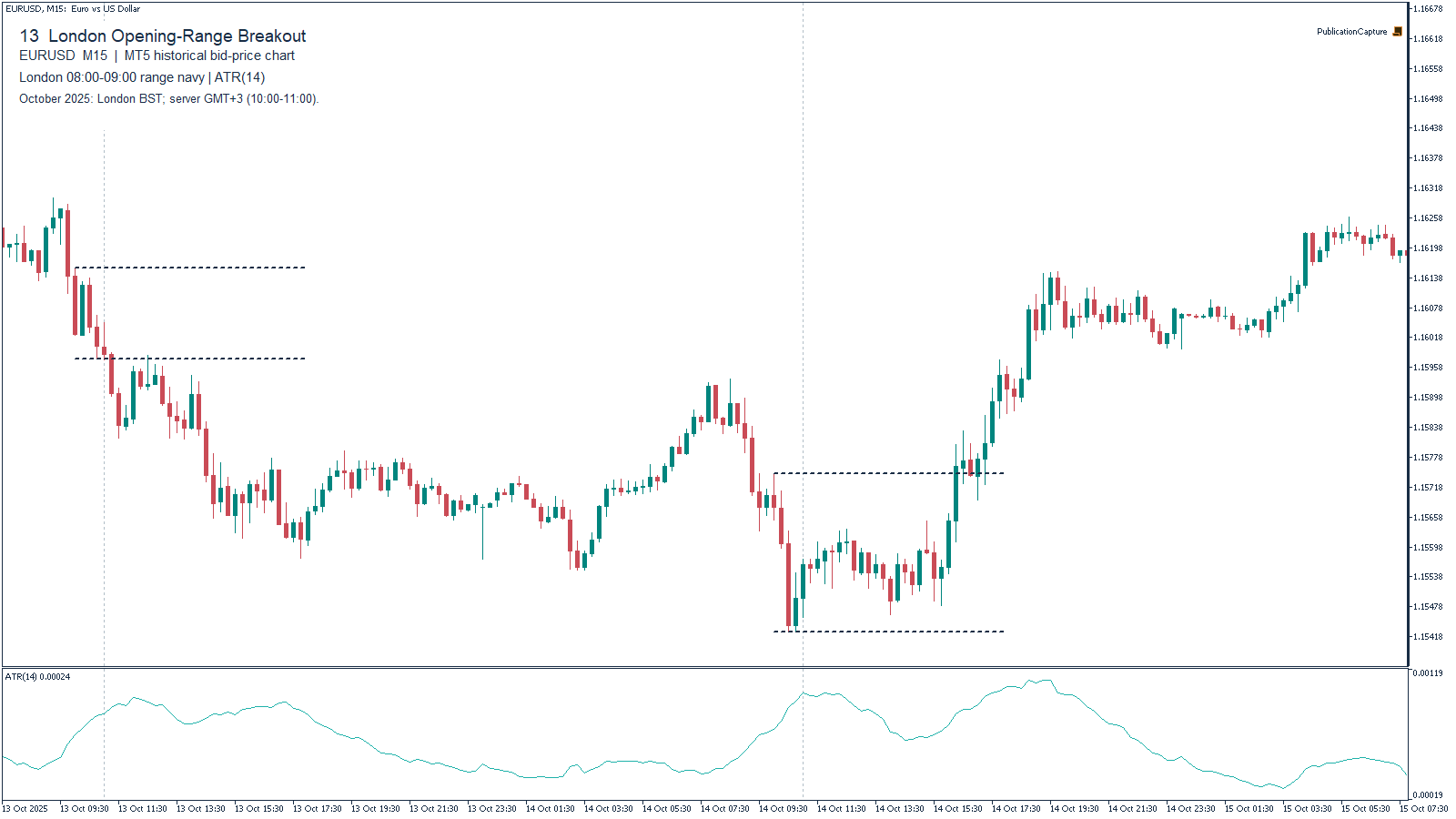
The first London hour creates a fixed, time-defined price range. The method tests whether a later excursion continues after activity increases; it does not assume every London open trends. Range construction, daylight saving and an OCO race are central implementation details. The forced same-day exit changes the method from a general breakout into an intraday specification.
Setup
- Use four M15 candles beginning 08:00, 08:15, 08:30 and 08:45 Europe/London. At 09:00 freeze their high and low. Convert each historical date using Europe/London daylight-saving rules and the broker’s documented server offset; an assumed permanent UTC offset is invalid.
- Trade only if range width is 0.5–4.0 × ATR14 of the final completed M15 bar. Require valid quotes and spread no more than 10% of the range. Maximum one filled trade per London date.
Indicators
- Opening-range high/low
- ATR(14)
- optional economic calendar filter
Long entry
- At 09:00 London place a buy stop one trade tick above the frozen range high, only if current ask is still below that trigger. Do not chase an already-triggered price. Cancel an unfilled order at 12:00 London.
Short entry
- At 09:00 London place a sell stop one trade tick below the frozen range low, only if current bid remains above it. Cancel at 12:00. Cancel the opposite order immediately after a fill; OCO implemented by client software can still race during fast markets.
Stop loss
- Long SL = range low − one tick; short SL = range high + one tick. Skip if actual fill-to-stop distance exceeds 4×frozen ATR14 or is less than three spreads. Never assume the pending trigger was the fill price after a gap.
Exit
- Take half at 1R. After that fill, tighten the remaining long SL to the lowest low of the previous two completed M15 bars minus one tick; for short, the highest high plus one tick. Never loosen the existing stop. Skip entry if half-volume cannot satisfy the broker volume step and minimum.
- At 16:00 London close the remainder at the first available quote and cancel every outstanding entry order. No overnight position is intended.
Risk and position size
- Risk 0.25% equity because this is an event-sensitive intraday rule. Simultaneous GBP and EUR exposures must remain below 0.5% combined risk.
Costs and execution
- Session labels are not broker-server timestamps. Store both London and broker times, execute with bid/ask stops, and include commissions and realistic stop-order slippage; swaps normally do not apply.
When the method can fail
- Avoid UK bank holidays, days with top-tier UK/euro-area releases near the range or breakout, and abnormal spreads at session transition.
Worked example
- Hypothetical London range 1.1000–1.1020 and M15 ATR14 0.0010 has width 2×ATR and passes the width filter. Buy trigger 1.10201, stop 1.09999 and actual fill 1.10210 give 21.1 pips of risk. The first partial target is 1.10421. These prices illustrate arithmetic, not a recorded London trade.
Historical test results
No tested pair meets the complete research-screen criterion. Positive cells alone do not qualify the strategy.
24 mechanical runs across 4 pairs on M15. Decisions use completed strategy bars; fills use native ICMarketsEU-Demo M15 Bid candles with explicitly modelled costs. Full window: 1 January 2025–18 September 2026. Each row starts with an independent USD10,000 account.
| Pair | Period | Costs | Trades | Net return | Profit factor | Max drawdown | Ambiguous bars |
|---|---|---|---|---|---|---|---|
| EURUSD | combined | base | 296 | -1.70% | 0.9446 | 4.39% | 1 |
| EURUSD | combined | stress | 83 | -2.72% | 0.6994 | 4.09% | 0 |
| GBPUSD | combined | base | 361 | -4.16% | 0.8915 | 6.51% | 6 |
| GBPUSD | combined | stress | 179 | -1.63% | 0.9076 | 3.17% | 0 |
| EURGBP | combined | base | 17 | -0.86% | 0.5596 | 1.19% | 0 |
| EURGBP | combined | stress | 1 | -0.17% | 0.0 | 0.19% | 0 |
| GBPJPY | combined | base | 333 | -4.57% | 0.8703 | 8.94% | 6 |
| GBPJPY | combined | stress | 125 | -2.75% | 0.7777 | 4.07% | 0 |
Show 2025 and 2026 separately
| Pair | Period | Costs | Trades | Net return | Profit factor | Max drawdown | Ambiguous bars |
|---|---|---|---|---|---|---|---|
| EURUSD | 2025 | base | 189 | -0.63% | 0.9682 | 3.31% | 0 |
| EURUSD | 2025 | stress | 68 | -3.40% | 0.5824 | 3.98% | 0 |
| EURUSD | 2026 | base | 107 | -1.07% | 0.9029 | 2.97% | 1 |
| EURUSD | 2026 | stress | 15 | +0.64% | 1.6825 | 0.42% | 0 |
| GBPUSD | 2025 | base | 212 | -4.03% | 0.8275 | 6.12% | 4 |
| GBPUSD | 2025 | stress | 122 | -0.96% | 0.9216 | 2.45% | 0 |
| GBPUSD | 2026 | base | 149 | -0.48% | 0.9698 | 2.48% | 2 |
| GBPUSD | 2026 | stress | 57 | -0.85% | 0.8497 | 1.52% | 0 |
| EURGBP | 2025 | base | 16 | -0.67% | 0.6212 | 1.19% | 0 |
| EURGBP | 2025 | stress | 1 | -0.17% | 0.0 | 0.19% | 0 |
| EURGBP | 2026 | base | 1 | -0.20% | 0.0 | 0.20% | 0 |
| EURGBP | 2026 | stress | 0 | +0.00% | n/a | 0.00% | 0 |
| GBPJPY | 2025 | base | 209 | -1.96% | 0.9101 | 5.22% | 4 |
| GBPJPY | 2025 | stress | 92 | -1.19% | 0.8668 | 2.39% | 0 |
| GBPJPY | 2026 | base | 124 | -2.42% | 0.8242 | 3.83% | 2 |
| GBPJPY | 2026 | stress | 33 | -1.47% | 0.579 | 2.02% | 0 |
Costs, execution and qualification criteria
Base: Spread 1.0 pip for majors; 1.5 EURGBP/EURJPY; 2.0 GBPJPY/AUDNZD. USD7/100k round-trip commission; 0.1 pip adverse market/stop slippage per fill. Financing=max(negative current native swap,0.2pip/night), no positive credit, native triple-swap day.
Stress: Double base spread; 0.3 pip adverse slippage/fill; same commission; double max(negative current native swap,0.5pip/night).
Research candidate only if a pair has >=30 trades in EACH calendar subperiod, positive net returns and PF >=1.10 in EACH subperiod under BOTH cost scenarios, and combined maximum drawdown <=15% under BOTH scenarios. Not a statistical profitability proof. All pairs and failures are retained.
Profit factor is the sum of positive net trade results divided by the absolute sum of negative results. Drawdown includes adverse M15 intrabar marks. The end of each test window liquidates open positions, so separate subperiod returns do not add exactly to the continuous-window return.
- Bar execution, not a real-tick MT5 Strategy Tester run. Same-bar ambiguity is treated adversely and counted.
- Current swap snapshot is an explicit stress assumption, not historical funding.
- One isolated USD10,000 account per strategy/pair, leverage ceiling30, broker minimum lots and steps. Results cannot be added into one portfolio.
- 2026 is a later evaluation slice, not untouched independent out-of-sample evidence; no parameter optimization was performed.
- Retrospective scheduled MT5 calendar may contain revised release times. UTC export normalized to NY-close broker clock against BLS releases.
- General discretionary event avoidance is fixed as high-impact events for either currency +/-30min. IDs1/17 next60min; ID20 next120min. ID13 UK bank holidays excluded. Subjective trend quality, unscheduled events and all-country holiday/session quality are not fully quantifiable; these are documented mechanical variants.
- Sparse broker histories are reported with shorter effective coverage and are ineligible for a candidate label.
- Native indicator parity: ATR, SMA, RSI, MACD, bands, stochastic, WPR, CCI and Ichimoku matched native buffers on EURUSD H4 within rounding tolerance; Wilder ADX matched the MetaQuotes ADXW example. EMA200 seed residual at 1,000 bars was 0.000000715, falling below 0.0000000001 after 2,000 bars.
- Built-in iSAR differs from the published MetaQuotes example on reversal bars. ID9 therefore uses actual built-in iSAR buffers exported by MT5, joined by timestamp, not the approximate Python SAR. Native GBPUSD/USDJPY SAR history needs 300 warm-up bars from January 2025, so those rows start later and cannot pass the full-period screen.
- 37 automated checks passed: execution gaps, short ask prices, ambiguous stop/target candles, partial commissions, pending expiry, time zones, rule regression cases and monthly portfolio no-lookahead/cash costs.
Interpretation: these are mechanical bar-model tests, not verified real-tick or live performance. Price rules were held fixed; subjective market-quality exclusions remain outside the mechanical model. Strategy adaptation requires a new test.
Download all test metrics and assumptions (JSON) · Download simulated trade logs and reproducible research code · Broker commission and swap documentation
Execution conventions
- Bar [0] is forming; [1] is the most recently completed bar. Unless explicitly stated otherwise, indicators use Close with zero plot shift and signals use completed bars. EMA is exponential, SMA is arithmetic and MT5 ATR is its native true-range average. Use at least 300 completed warm-up bars; a longer rule-specific requirement takes priority.
- A close-based signal is executed at the first available quote after the close, never retrospectively at the signal close. Buy at ask, sell at bid; close longs at bid and shorts at ask. A standing stop or target can fill within a bar. A gap through a stop fills at the first executable price, which can be worse than the stop.
- R means the initial entry-to-protective-stop distance, fixed at entry. Convert that distance into account-currency loss using the symbol tick size and loss-side tick value. Lots = cash risk / loss per lot, rounded down to the broker volume step. Round prices to the trade tick and recheck risk plus minimum stop/freeze distances before submitting. Budget commission and slippage separately; skip if minimum size exceeds the risk limit.
- Use one position per symbol and no averaging down. A trailing stop only tightens after a completed bar and becomes active on the next quote. The entry bar is holding bar one; a time exit executes on the quote after the specified holding bar closes. When a hard stop and a close-based exit compete, the stop already active takes precedence. With OHLC-only data, assume stop before target if both can occur in one bar; tick data is needed to resolve the order.
- The article defines the price rule. Any discretionary news exclusion changes the tested variant and must be recorded in advance. Map broker timestamps to the named London/New York time zone using historical daylight-saving offsets; do not assume a fixed UTC offset. Include spread, commission, slippage, overnight financing and triple-swap days in a profitability test.
Adapt and test your version
- Treat these inputs as a reproducible starting specification. Choose a currency pair, session and holding period that match the time you can monitor the market, then record any changes to indicator periods, thresholds, stop distance or exits as a new version.
- Change one hypothesis at a time. Reserve a later period and additional pairs for evaluation before looking at their results. Include your account’s actual trading and financing costs, compare small parameter changes, and forward-test on demo. A selected profitable window does not validate the strategy or its modified version.
Reproduce the chart in MT5
- Open EURUSD on M15. Add the indicators listed above through Insert → Indicators; use Close and zero shift unless a different setting is specified. The Data Window displays exact values for the selected completed candle.
- Compare the signal candle with the required earlier bars before moving forward. Use the crosshair to read prices and times. For custom channels, session levels or Supertrend, reproduce the formula in this guide and check the calculation before relying on an external indicator.
- Draw entry, initial SL and target only after a candle has satisfied every condition. Label planned levels as plans; they do not demonstrate a historical fill. The featured chart is genuine historical MT5 context and is not a trade-performance report.
Sources
- MT5 Help: Chart timeframes — Indicator/platform definition; not strategy performance.
- IC Markets EU: Forex Product Specification — Broker chart timezone and New York close alignment; verify the historical offset for any session-based test.